Understanding Budgie Cage Bar Orientation: Myths, Realities & Practical Solutions for Vertical-Bar Bird Cages
Last Updated on by Mitch Rezman
An In-Depth Guide for Budgie Owners Who Want the Best for Their Birds
When it comes to caring for budgies—those lively, feather-light dynamos of the avian world—even a detail as seemingly minor as cage bar direction can prompt concern.
Many new bird parents discover only after purchasing a cage that the model they chose features predominantly vertical bars, while the overwhelming advice online seems to champion horizontal-bar cages for climbing ease.
And so begins a familiar worry.
“Did I buy the wrong cage?”
“Will my budgies struggle forever?”
“Is there something I can add to make their environment better?”
This expanded, deeply detailed guide—rooted in the original exchange you shared—aims to answer all of those questions and more. If you’ve ever wondered whether vertical bars affect budgie health, climbing strength, confidence, or general enrichment, consider this your definitive resource.
Table of Contents
- The Source of the Concern: Why Budgie Owners Fear Vertical Bars
- Budgie Biology & Natural Climbing Behavior
- Myth vs. Reality: The Zoo Cage Misconception
- Vertical vs. Horizontal Bars: Do They Really Matter?
- How Budgies Adapt Over Time to Different Cage Structures
- Enhancing a Vertical-Bar Cage: Practical Additions That Change Everything
- Ladders
- Long toys
- Perch placement
- Booda rope perches
- Strategic enrichment positioning
- Strengthening Your Budgie’s Grip & Confidence
- Environmental Design: Creating a Multi-Level Playground
- How to Choose Accessories That Complement Vertical Bars
- Long-Term Care: Maintaining a Safe, Climb-Friendly Space
- Final Thoughts: You Didn’t Choose the Wrong Cage—Here’s Why
1. The Source of the Concern: Why Budgie Owners Fear Vertical Bars
Many budgie owners encounter a moment of mild panic after they purchase a cage that features predominantly vertical bars. Countless blogs, social groups, and forums repeat the same warning: “Parrots can’t climb vertical bars. They need horizontal bars!”
This creates a sense of alarm—especially for first-time owners who desperately want to provide the best environment for their birds.
But here’s the truth:
The fear surrounding vertical bars is based on historical context and outdated assumptions, not on the reality of modern pet bird care.
Understanding where this fear originated is the first step in dispelling it.
2. Budgie Biology & Natural Climbing Behavior
Budgerigars (Melopsittacus undulatus) are inherently agile creatures. In the wild, they spend much of their day:
- hopping across branches
- scaling tree bark
- maneuvering through foliage
- fluttering vertically from low to high perches
- using beak-and-foot coordination to stabilize themselves
Contrary to some assumptions, budgies do not rely solely on bar orientation to determine how well they climb. Their feet—zygodactyl in design—feature two toes forward and two toes behind, giving them unusually strong grasping abilities.
Their beak acts as a third limb.
Their wings offer micro-balance corrections.
Their tails provide vertical stability.
Even in environments without “horizontal ladders,” budgies thrive in vertical landscapes.
This means that vertical bars aren’t inherently a problem—they’re simply different from what some owners expect.
3. Myth vs. Reality: The Zoo Cage Misconception
The worry about vertical bars actually arises from an old and somewhat dramatic image: the iron-bar zoo cages of decades past.
These heavy, widely spaced, unapologetically vertical bars created an unintended issue for larger parrots. When climbing these structures, parrots would inch upward, then—because there was nothing to grip horizontally—slide downward using their beaks.
This repetitive sliding caused:
- friction
- wear
- grooves in the beak surface
This phenomenon became well-known and ultimately led to the widespread belief that vertical bars = beak damage.
But here’s the important distinction:
Those cages were massive, outdated, and made from thick, grooved iron—not the powder-coated steel or stainless steel used in today’s companion bird habitats.
And perhaps even more crucial:
Budgies are far too small to replicate the sliding behavior seen in the large parrots of those historical zoo enclosures.
Thus, the concern persists primarily as a myth, not a practical reality.
4. Vertical vs. Horizontal Bars: Do They Really Matter?
Modern cages often include both vertical and horizontal bars because they serve different structural purposes. Vertical bars usually contribute to cage stability, while horizontal bars provide additional rigidity or aesthetic balance.
For budgies:
- Horizontal bars can offer an easier “staircase-like” structure for climbing.
- Vertical bars may require slightly more grip strength but are far from unusable.
- Their beak acts as an anchor point in either direction.
- Their feet adjust naturally to bar orientation over time.
What may appear as “struggling” is often simply the learning curve of a new environment.
It’s important to note that most budgies adapt quickly, gaining confidence as they grow familiar with the cage layout.
5. How Budgies Adapt Over Time to Different Cage Structures
Every budgie has a different starting point:
- Age
- Strength
- Prior cage experience
- Amount of daily exercise
- Personality (some are acrobats; others are cautious climbers)
Younger or newly acquired birds may appear hesitant within the first few days or weeks in a new cage. This is perfectly natural. They are mapping new routes, testing distances, and learning how the “architecture” works.
Within a short period, most budgies:
- become stronger
- grip more confidently
- find favorite climbing paths
- learn how to use perches, toys, and bars together
- develop muscle memory
This strengthens not only their legs and feet, but also their balance, coordination, and beak dexterity.
In other words:
Your budgies will adapt—and they will likely thrive.
6. Enhancing a Vertical-Bar Cage: Practical Additions That Transform the Experience
If you still feel compelled to further enhance the climbing experience (and many owners do), there are numerous additions that can dramatically improve mobility, fun, and comfort.
A. Ladders: The Instant Climbing Upgrade
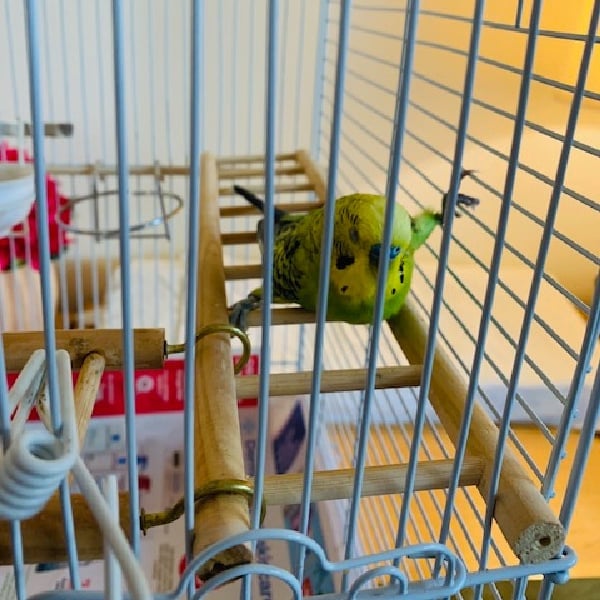
Adding a ladder or two can convert a vertical-bar space into a highly accessible climbing grid.
Ladders:
- provide direct upward and downward movement
- help young or less confident birds build strength
- give older birds easier routes
- appeal to budgies’ instinctive desire to “walk upward”
Wood, rope, acrylic, or stainless steel ladders all work well.
B. Long Hanging Toys as Climbing Assist Points
Long toys—especially soft rope toys, paper chains, or woven vine tunnels—act as secondary routes and gripping points.
Placed near cage walls, they:
- give budgies something to lean against
- create a hybrid climbing surface
- reduce the dependency on bar orientation
- add enrichment that keeps them mentally stimulated
A simple vertical rope toy placed near the bars can eliminate the need for horizontal bars entirely.
C. Perch Placement: The Hidden Key to Better Mobility
Perches are not just resting spots—they’re bridges.
To improve climbing ease:
- place perches at staggered heights
- create step-like arrangements
- angle a perch diagonally across a vertical-bar section
- include varying textures (wood, rope, natural branches)
This creates a dynamic environment, allowing budgies to maneuver without relying solely on the bar layout.
D. Rope Perches (Booda Perches): A Game Changer
A Booda perch—especially a 21-inch or 32-inch model—acts like a flexible pathway.
Benefits include:
- bendable shape
- soft, textured surface for gripping
- endless configuration options
- ability to create spirals, ramps, or staircases
Placed strategically, a Booda perch becomes a customizable ramp system, turning even a fully vertical-bar cage into an easily climbable playground.
E. Accessory Placement Strategy
Rather than focusing on the bars themselves, think of the cage as a 3D space.
Items placed near vertical bars give the budgies extra gripping options:
- a long rope toy placed parallel to the bar wall
- a natural branch running along the side
- a toy ladder angled diagonally
- a foraging toy suspended halfway down
Even one well-placed accessory can change how your budgies interact with the entire cage.
7. Strengthening Your Budgie’s Grip & Confidence
Budgies naturally develop strength over time. But you can support that development with:
- opportunities to fly outside the cage
- multiple surface types (rope, wood, textured toys)
- perches at various diameters
- climbing nets
- soft ropes that encourage beak-grip practice
The more variety they encounter, the stronger and more capable they become.
8. Environmental Design: Creating a Multi-Level Playground
To improve a vertical-bar cage, imagine you are designing an indoor tree canopy with:
- low landing pads
- mid-level activity stations
- upper-level resting spots
- playful hanging areas
This vertical diversity makes bar direction practically irrelevant, because the birds learn “routes” that rely on features, not bars.
9. How to Choose Accessories That Complement Vertical Bars
When selecting items, choose accessories that:
- allow multi-point gripping
- have soft or textural surfaces
- are flexible enough to shape
- offer vertical and horizontal movement
- attach well to vertical bars without wobbling
Examples include:
- rope spirals
- woven climbing mats
- branch ladders
- sisal ropes
- spiral swings
- cascading foraging toys
All of these invite climbing without needing horizontal bars at all.
10. Long-Term Care: Maintaining a Safe, Climb-Friendly Space
Ensure the cage remains a safe environment by:
- rotating toys weekly
- checking for frayed ropes
- tightening perch attachments
- cleaning rope perches regularly
- monitoring your budgies’ foot health
- ensuring the cage has safe spacing between bars
With good maintenance, even a simple vertical-bar cage becomes a thriving, enriched habitat.
11. Final Thoughts: You Didn’t Choose the Wrong Cage—Here’s Why
Budgie owners often feel guilt or anxiety when they discover that their cage doesn’t align with commonly circulated opinions. But the real story is far more reassuring:
- Vertical bars are not harmful.
- Modern cage materials eliminate old risks.
- Budgies adapt beautifully to different environments.
- Accessories can create infinite climbing options.
- Strength and agility develop naturally with time.
Your birds will grow stronger, more confident, and more skilled as they explore their environment. With a few well-placed enhancements—ladders, long toys, rope perches, or natural branches—you can turn any cage, vertical bars or not, into a dynamic, joyful home.
Your budgies do not just adapt—they thrive.
Author Profile

Latest entries
 Feeding Exotic BirdsDecember 29, 2025How to Switch or Convert Your Bird From Seeds to Pellets: Real-Life Case Studies and Practical Guidance
 Feeding Exotic BirdsDecember 16, 2025A Practical, Budget-Smart Guide to Feeding Birds Well
 Bird EnviornmentsDecember 7, 2025Understanding Budgie Cage Bar Orientation: Myths, Realities & Practical Solutions for Vertical-Bar Bird Cages
 Feeding Exotic BirdsDecember 5, 2025How Dr. T.J. Lafeber Rewrote the Future of Pet Bird Nutrition