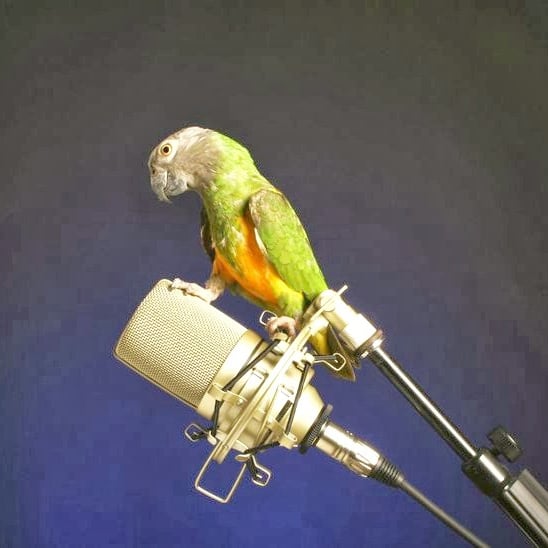
How Can Parrots Be Recognized by Their Voices?
Introduction
Have you ever noticed how you can tell who is talking, even if you can’t see them?
Maybe you know it’s your mom calling you from another room, or your friend shouting across the playground.
Introduction
Have you ever noticed how you can tell who is talking, even if you can’t see them?
Maybe you know it’s your mom calling you from another room, or your friend shouting across the playground.
Hi Mitch
Enjoy your newsletter each week.
I have a 32-year-old Senegal that is showing some new behavior. While he is out of the cage and getting his special time he always enjoys having his head scratched, just recently when trying to rub or scratch he will begin to shake his head and then look like he has vertigo.

So, you've got yourself a Senegal parrot, and it's decided to turn into a tiny, feathered T-Rex! Don't worry, we've got you covered. Here are some reasons why your parrot…

Barbara is concerned about her Sennie:
My 23 yr. old Senegal has stopped eating his Harrison’s pellets which he has been eating most of his life.
He is eating fruit, veggies, Nutriberries & Avicakes.
Should I be concerned?
Should I try a different pellet? Thank you for your help.

From: Donna L.
Subject: Dangers found in toys and Oops, wrong Donna?
Hi Mitch,
I received your informative lesson about the dear little budgie? (Sorry, tiny strokes-no memory)
I couldn’t stop reading. So happy I found you!
I started to dismantle my sweet little 21-year-old Meyer’s parrot’s toys to DIY new ones.
Lynn H. replied to Patrick B.
I have a 27-year old Senegal.
I was reading your post (below) and thought I would offer a few suggestions to you.
First, as Mitch said, try clicker training.
It is basically positive operant conditioning.
Birds do not understand the word “no” and yelling at them will teach them how to scream.
So please give it a try.

The following is in response to our feathered community member Patrick.
Hi Patrick B,
I have a 27-year old Senegal. I was reading your post and thought I would offer a few suggestions to you. First, as Mitch said, try clicker training. It is basically positive operant conditioning. Birds do not understand the word “no” and yelling at them will teach them how to scream. So please give it a try.

Editor’s note: sometimes we combine several answers into a post to make for more interesting and efficient reading endnote
Hi Mitch,
In response to the comment about travel cages, I have found a solution.
My Senegal parrot (Gonzo) did not like to hang out in a smaller cage.
So I got her a reasonably-sized cage that I can use for her travel or if she needs to stay with someone.
I can drive with it and strap the cage into a seat belt.
I set it up in another room and left the cage door open. She has started playing inside it and seems to like it.
Now, with COVID-19, I am working from home, and need it to be quiet when I’m on the phone.

Sherry L. comments:
Yes, my birds are fed ‘chop’ (Arlo the grey, calls it ‘bobbity’) This is a new term for what I have done for 28+ years.
Chop is chopped veg, grains, and sometimes, a tiny bit of seed sprinkled on top or a bit of walnut, or something.
I used to cut the vegetables larger because Arlo was pretty accepting of lots of things, and I didn’t have a food processor.
I also (now) feed Arlo a pelleted diet, along with the chop.
She also gets a small amount of fruit, and sometimes about an inch square of chicken breast (baked) or some steamed scallop (yum).
Joe S. seeks an answer:
I am looking for advice on how to best transition our birds to our new home.
We are moving into a new house next week (not long-distance, just across town).
We have a 6 yo Senegal and a 5yo parrotlet who have only lived at our current home.
I know that birds can be very stressed by changes like this, and I want to make this move as easy as possible for them.
“Appreciate the advice and love reading your blogs!”